The Brandon Museum and Visitors Center Presents:
The History of Brandon, Vermont, from its earliest days through the present.
Come learn about the people, politics, industry, and geography of this small town nestled in the foothills of the Green Mountains. In many ways, the history of Brandon is the history of Vermont.
A Village Between Two Ranges
Brandon is nestled in a valley at the confluence of Otter Creek and the Neshobe River and between the Taconic Mountains to the west and the Green Mountains to the east. These ranges were formed 450 million years ago as a pre-Atlantic Ocean, known as the Iapetus Ocean, began to close. The impact forced the land, as well as sediments that had been on the ocean floor, upward to form these two mountain ranges. This resulted in unique geological features that have been studied and documented by the U.S Geological Survey and geologists. A lignite deposit discovered in the 1840s lead to a survey which demonstrated that Brandon was once a subtropical humid environment. Fossils embedded in Brandon lignite date to the Cenozoic Era (5 to 23 million years ago). Geological publications describe the fossils to be the most diverse angiosperm in eastern New England consisting of fruits, seeds, pollen, and wood from a time when Brandon’s climate was like the Gulf coast of the US.
This area was home to the Western Abenaki during the Woodland Period 2900 to 400 years BP (Before Present). The Woodland Period is viewed as the most complex Native American period in the Champlain Valley. The region’s native people had developed a culture based on the selective borrowing of ideas and innovations from other people with whom they had contact for over 9000 years. This area was an ideal homeland due to its plentiful resources and to the Otter Creek serving as a river highway for movement up and down the valleys.
For the early settlers arriving here in the late 1700s, water, iron ore, timber, marble, and farmland were plentiful and became the basis for the town’s location and prosperity in the 1800s. The discovery of marble, lignite, kaolin, manganese, and iron enabled Brandon to become a thriving manufacturing center in the 1800s. Brandon was home to a cast of significant contributors that included Thomas Davenport, inventor of the electric motor, Stephen A. Douglas, who famously debated Abraham Lincoln during the presidential race, and John Conant, who advanced cooking technology from the fireplace to his invention of the cast iron cookstove, known as ‘the wonder of the farmer’s kitchen’.
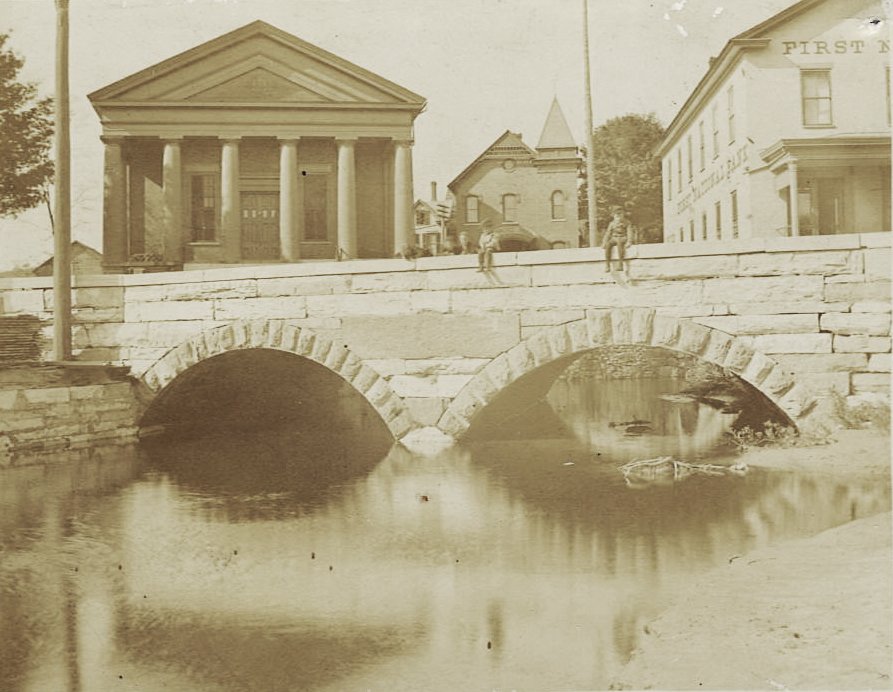
Today, Brandon’s 19th-century townscape remains intact, exhibiting Federal, Greek Revival, Italianate, Second Empire, Colonia, and Victorian architecture throughout the village. A total of about 250 buildings comprise Brandon’s National Historic District designation which was obtained in 1976. Click here to read.
